
- Solvay Brussels School of Economics and Management
- Homepage
- Research
- Faculty Initiative - Sustainable Development Initiative
-
Share this page
The Sustainable Development Initiative
What motivates me is the dual conviction that our teaching must reflect the state of the art, and that companies and public policies have a key role to play in the transition.
The Sustainable Development Initiative (SDI) is a school-wide initiative to support and federate individual projects and catalyze changes in our education programmes, research, and beyond, that contribute to the transition toward a more sustainable economy. The initiative is coordinated by a small group of faculty members, staff, and students, engaging with the rest of the organisation and driving change in their respective roles and functions.
History of the Sustainable Development Initiative
Our story in a nutshell
+
Our full story
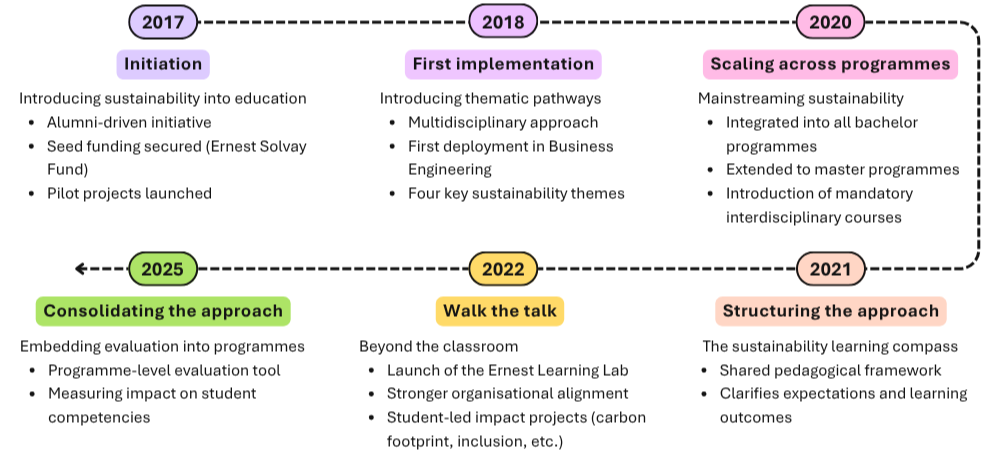
The SDI evolved over time to address challenges and seize opportunities, and as a result, moved from focusing solely on teaching to also engaging the organisation more broadly.
It all started in 2017 when two alumni, Michel Bande and Eric De Keuleneer, contacted the Dean at the time with a simple message. The United Nations Sustainable Development Goals had been adopted two years earlier and were driving change across all areas of business and policy. “We need to make sure our graduates are sustainability literate”, they said. At the time, only a handful of professors integrated sustainability-related content in their courses. Many felt they lacked the knowledge or time to do so. Overall, students felt they were not exposed to sustainability challenges.
The two alumni helped the School secure seed funding from the Ernest Solvay Fund, with one request: ensure that sustainability is integrated into existing subjects rather than presented as an add-on “icing on the cake.” The first year, we took the time to explore the best ways to do this. We looked at what other business schools were doing. We also funded six pilot projects proposed by faculty members to better understand existing barriers and needs.
Our first major milestone was the introduction of sustainability thematic pathways in 2018. Pathways are an innovative pedagogical mechanism that brings together professors from different disciplines across a programme. They reflect on how their courses contribute to knowledge and skills related to a specific sustainability theme and work together to develop an integrated coverage of their theme. Thematic pathways have many advantages when it comes to sustainability. First, they are multi-disciplinary by design, exactly what is needed to approach problems holistically. Second, they focus on a theme, thereby reducing professors’ concern about their lack of expertise in sustainability more generally. Pathways build on their expertise. Third, they are collective, fostering conversations across people and disciplines and creating momentum. The first thematic pathways were introduced in the Bachelor's in Business Engineering and covered four themes: energy, circular economy, socially sustainable organisations (initially called “work & people”), and human development. They led to changes in course content and the introduction of new interactive activities and student projects.
2020 was another important year. Sustainable development was included in the learning objectives of all undergraduate programmes of the School. Thematic pathways were deployed in two other programmes, the Master in Business Economics and the Master in Management Science. Last but not least, a compulsory interdisciplinary course on sustainability was introduced in each bachelor programme. The courses was designed to provide students with the scientific, historical, and epistemological foundations of sustainable development, relieving faculty members teaching business and economics subjects from doing this while helping students understand the big picture.
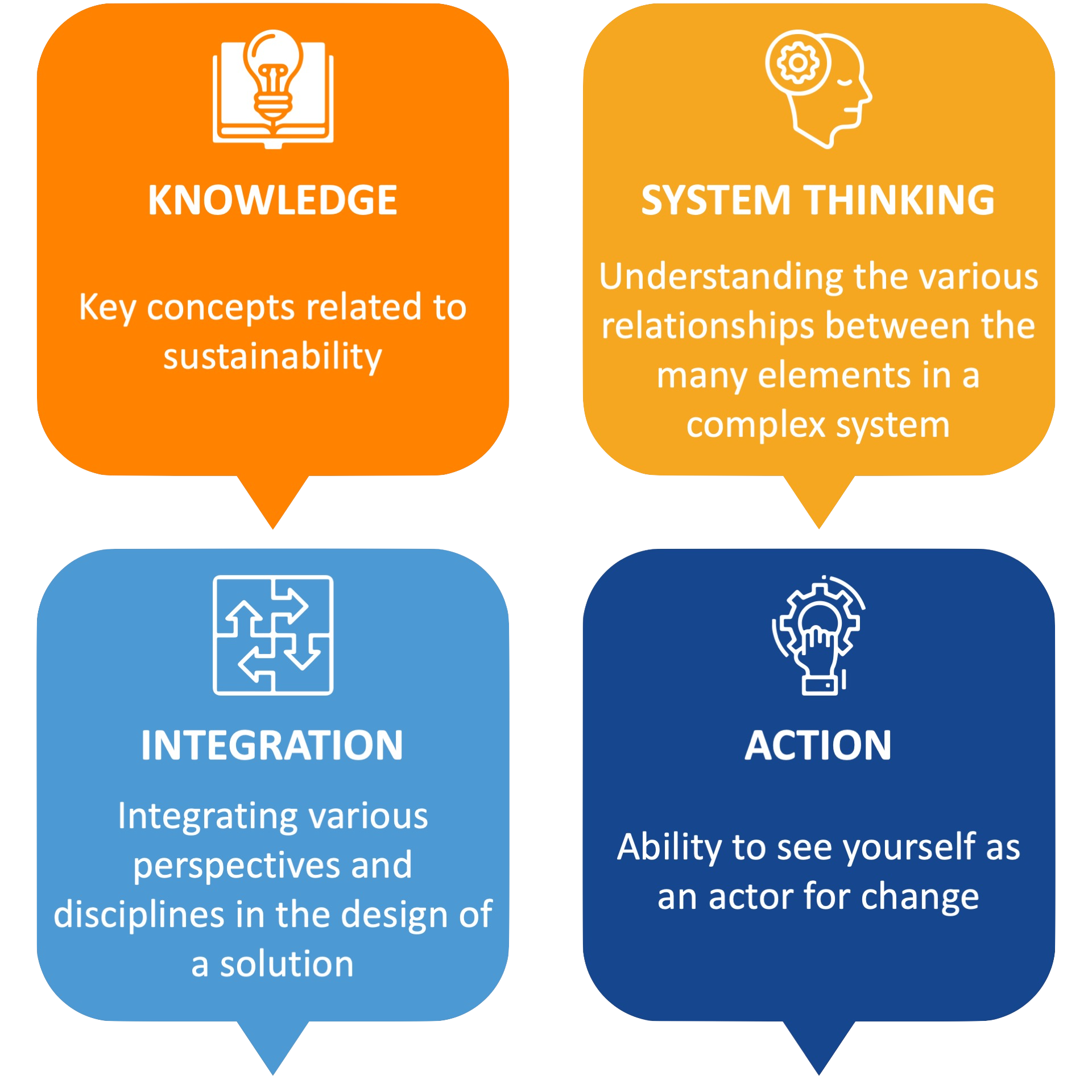
2021 saw the introduction of the Sustainability Learning Compass. The Compass captures what integrating sustainability into our educational programme means. It plays a critical role in clarifying expectations and engaging with professors on sustainability.
In 2022, the SDI took an important turn. It became apparent that you cannot change what you teach and how you teach it, without engaging the organisation more broadly. There needs to be coherence between how the organisation works and behaves, and what we teach. We acted on two fronts.
 |
First, we launched the Ernest Learning Lab, a school-wide series of activities and events aimed at transforming the School into a learning community where everyone, not only students, could experiment and share new ideas, learn new skills, and exchange ideas on subjects central to our missions of research, education, and service to society. The philosophy of the Ernest Learning Lab is to foster change at the School by and for its staff, students, instructors, and researchers. |
In 2025, after some experimentation, we finally closed the loop of our education transformation journey by introducing a programme-level evaluation tool of students’ sustainability literacy skills using the Compass. The tool helps programme directors and individual faculty members assess their programme and course effectiveness in fostering sustainability literacy.
For more details, check out our recent activity reports:
SDI partners
By design, the Sustainable Development Initiative is a collective project. Its success is the result of the input and support of many people, both participants and supporters.
At ULB, we work closely with reACT, the university-wide network for social and ecological transformation, CAP, the pedagogical support department, and the Environment and Mobility department.
  |
We are grateful to our two corporate partners, UCB and ETEX, who have been supporting us since 2021. Beyond contributing to funding the initiative, corporate partnerships are important because when it comes to sustainability, practice is sometimes ahead of academic knowledge, and the corporate world therefore offers valuable insights for education and research. Companies also offer the ultimate testbed for the relevance of what we teach. |
In that spirit, we have been co-organising the Business & Society symposium with our partner UCB since 2022. This initiative fosters cross-stakeholder collaboration to address societal challenges through capacity building, knowledge sharing, and networking. The symposium has produced a dozen case studies on organisational change and innovative governance mechanisms that leverage cross-stakeholder collaboration.