
-
Share this page
Education for sustainability
At the Solvay Brussels School of Economics and Management, sustainability is not a side topic but a core dimension of our educational mission. Our objective is to equip students with the knowledge, skills, and mindset required to navigate and shape the sustainability transformation of business and society.
+
A programme-wide approach
Sustainability is embedded across all our programmes through a coherent learning journey. Since 2020, sustainability has been integrated into the intended learning outcomes of our degrees, ensuring that all students are exposed to key sustainability challenges and develop the ability to address them in their future careers.
This integration combines:
- dedicated courses, providing students with the scientific, historical, and ethical foundations of sustainability
- discipline-based courses, such as chemistry, history, or psychology, which develop their discipline-specific knowledge base relevant to sustainability
- business and economics courses where sustainability-related challenges are embedded into core business and economics subjects
- experiential learning opportunities, allowing students to engage with real-world sustainability challenges
+
Our Sustainability Learning Compass
To operationalize our vision, we have developed the Sustainability Learning Compass based on ULB's sustainability competency framework (“socle de compétences en durabilité”). The Compass translates sustainability competencies into concrete learning objectives along four complementary dimensions:
Knowledge
Students develop a solid understanding of sustainability-related concepts, grounded in both scientific and social perspectives. By the end of their studies, they are expected to be able to:
- engage with and critically interpret the historical, scientific, and ethical dimensions of the relationship between humans and nature, and understand the current state of the planet and the interactions between human and natural systems
- analyse the major social challenges and inequalities associated with unsustainability
- mobilise appropriate concepts, frameworks, and tools to conduct qualitative and quantitative analyses of sustainability related challenges
- apply relevant methods to analyse, monitor, and manage sustainability-related issues within their field
Systems thinking
Students learn to approach sustainability challenges as part of complex, dynamic systems. This includes the ability to:
- identify and analyse the interconnections between economic, social, and environmental issues
- diagnose the underlying drivers and root causes of unsustainability
- structure complex problems by integrating feedback loops, trade-offs, and systemic effects
- understand and articulate the key dynamics and interdependencies between environmental, social, and economic systems
- incorporate complexity and uncertainty into analysis and decision-making
Integration
Students develop the ability to bridge disciplines, perspectives, and value systems. They are trained to:
- critically examine how assumptions, paradigms, and value systems shape knowledge, analysis, and decisions
- integrate insights from multiple disciplines and perspectives (e.g. geographic, temporal, individual vs. collective)
- analyse and compare stakeholder positions, interests, and constraints
- identify and articulate possible levers for action at both individual and collective levels
Action
Students are encouraged to see themselves as agents of change within a system, capable of initiating and driving change. This dimension focuses on:
- translating analysis into actionable and context-relevant solutions
- designing responses that account for trade-offs, constraints, and implementation challenges
- thinking critically, constructively, and creatively to develop robust solutions
- working collaboratively to navigate complexity, resolve conflicts, and support change processes
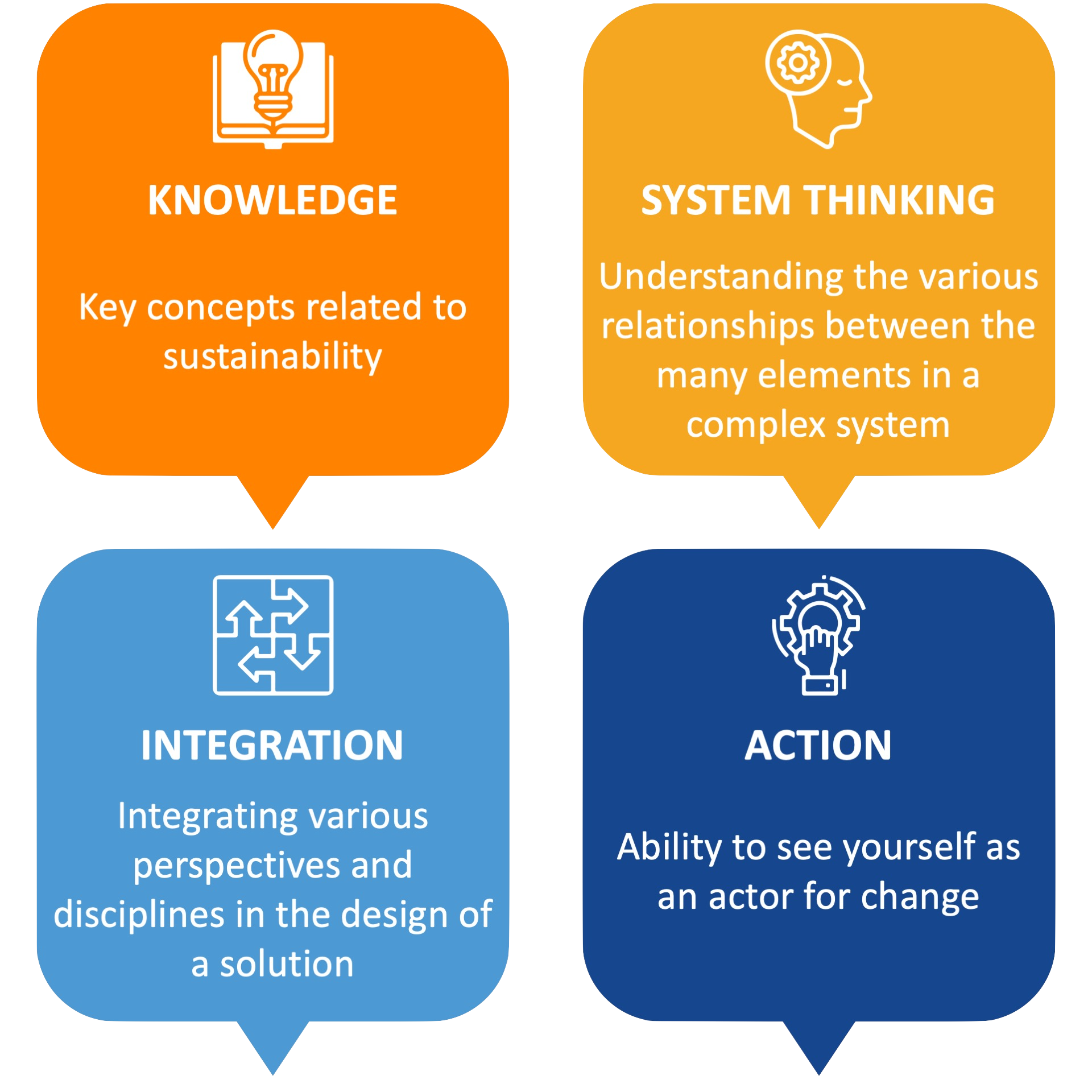
The four-dimensional Compass provides a common language across programmes and disciplines. It guides curriculum design, supports faculty coordination, and ensures that sustainability is addressed through a coherent learning journey rather than as a collection of disconnected topics.
These competencies are embedded in the learning objectives of all our programmes, alongside discipline-specific and transversal skills such as critical thinking.
+
Thematic pathways: coordinating learning across disciplines
Thematic pathways are a cornerstone of our pedagogical approach. They bring together professors from different disciplines within a programme to coordinate their teaching around a specific sustainability theme. These themes currently include energy, the circular economy, public governance, finance, sustainable business operations, socially sustainable organizations, and human development.
This approach enables:
- multidisciplinary learning, reflecting the complexity of sustainability challenges ;
- cumulative skill development across courses and academic years ;
- stronger coherence, ensuring that students build a structured understanding .
By building on faculty members’ expertise while fostering collaboration, pathways create a powerful mechanism for integrating sustainability into existing curricula.
+
Beyond the classroom
We believe that sustainability competencies cannot be developed through theory alone. Our programmes therefore aim to complement classroom learning with opportunities to engage with real-world sustainability challenges.
Students have the opportunity to engage in:
- field projects to solve real sustainability challenges
- collaborations with companies and institutions through internships
- sustainability-focused master’s theses
- extracurricular engagement, including initiatives that recognize student contributions to society
These experiences provide opportunities for students to deepen their understanding, confront real-world complexity, and further develop their ability to analyse, collaborate, and contribute to change.
Our strong links with corporate and institutional partners ensure that our teaching remains grounded in practice and responsive to evolving challenges. Sustainability issues are continuously reshaped by innovation, regulation, and societal expectations. By engaging with external stakeholders, we expose students to real-world decision-making contexts and ensure that our programmes remain aligned with these evolving dynamics.
Ultimately, our approach aims to equip graduates not only with a solid understanding of sustainability challenges, but also with the ability to navigate complexity, connect perspectives, and contribute meaningfully to the transformation of business and society.